


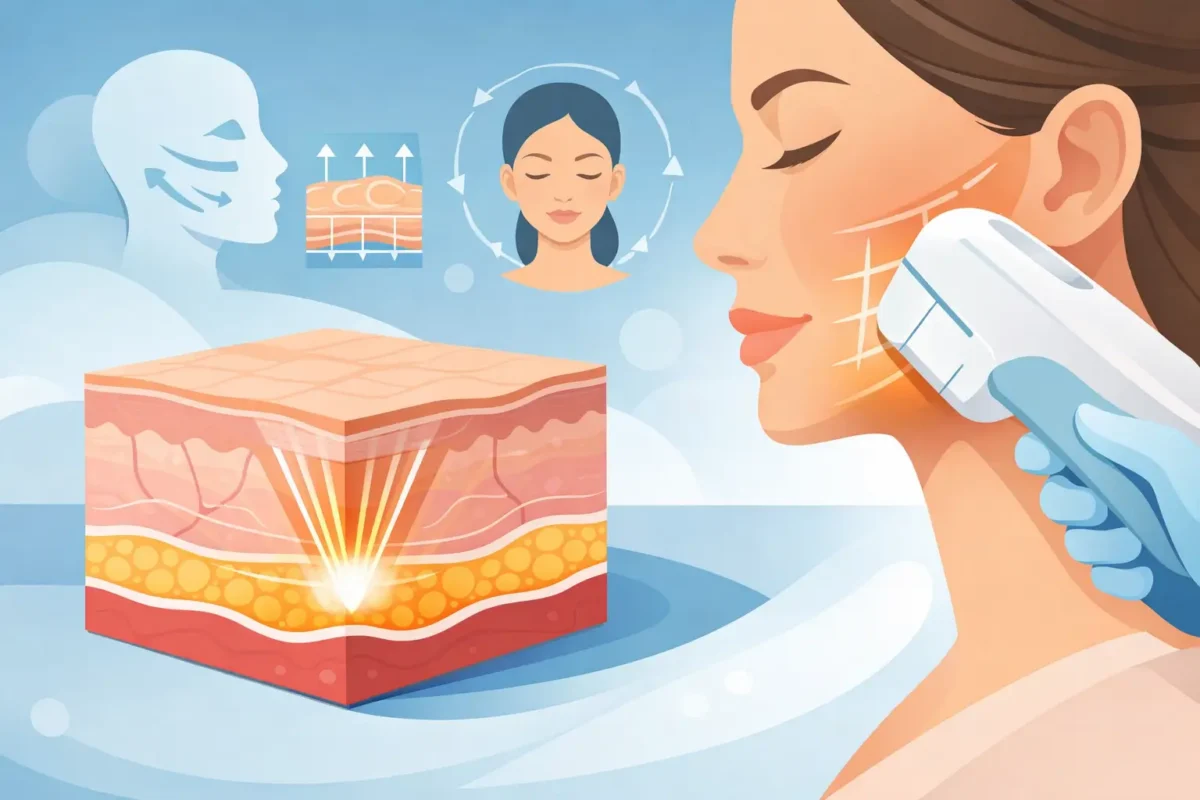
Loose jawline skin usually does not show up all at once. It tends to appear in photos first, then around the lower face, then in the mirror when makeup stops sitting quite the same way. That is why so many clients ask how HIFU skin tightening works – not just whether it is popular, but what it is actually doing under the skin and whether it can create a visible lift without surgery.
HIFU stands for high-intensity focused ultrasound. In aesthetics, it is used to deliver concentrated ultrasound energy into precise layers beneath the skin without cutting or damaging the surface. That detail matters. HIFU is not trying to peel, resurface, or freeze the top layer. Its goal is to reach deeper structural tissue, trigger a controlled healing response, and encourage the skin to become firmer over time.
How HIFU skin tightening works beneath the surface
The easiest way to understand HIFU is to think in terms of targeted heat. The device sends focused ultrasound energy to selected depths in the skin and supportive tissue. At those exact points, the temperature rises enough to create tiny thermal injury zones. These are intentional and highly controlled.
Your body responds by starting a repair process. That repair process stimulates new collagen production and collagen remodeling. Since collagen is one of the key proteins that gives skin structure and firmness, this gradual rebuilding can lead to tighter, smoother-looking skin.
One reason HIFU gets so much attention is that it can target deeper layers than many surface-based treatments. Depending on the area being treated, practitioners may work at different depths to address superficial skin laxity and deeper foundational support. This is why HIFU is often discussed as a non-surgical lifting treatment rather than just a skin-polishing treatment.
Why collagen matters so much
Collagen is often described in simple terms, but its role is worth understanding. Younger skin has stronger internal support, so it tends to snap back more easily and hold cleaner contours around the cheeks, jawline, neck, and brow area. As collagen declines with age, skin can start to look softer, thinner, and less defined.
HIFU does not replace surgery, and it does not create instant dramatic repositioning of tissue. What it can do is encourage the body to rebuild some of that lost support. For the right candidate, that translates into a firmer look, more definition, and a refreshed appearance that still looks like you.
This gradual effect is part of the appeal. Results typically develop over weeks to months as collagen production increases. For clients who want improvement without looking suddenly altered, that slower timeline can be a benefit rather than a drawback.
What areas can HIFU treat?
HIFU is commonly used on areas where mild to moderate skin laxity is most noticeable. The lower face is a frequent focus, especially the jawline and jowls. It is also often used on the neck, under the chin, and parts of the cheeks. In some cases, it may be used around the brow area to create a more lifted look.
Body treatments are possible too, although the goals and results differ from facial tightening. On the body, HIFU may be used to improve firmness in select areas where skin has become looser. The best treatment plan depends on tissue thickness, degree of laxity, and what kind of change a person is realistically hoping to see.
This is where a proper consultation matters. A treatment that works beautifully for early jawline softening may not be the best answer for heavier sagging or significant volume loss.
What HIFU feels like during treatment
Most clients want the science, but they also want the honest version of the appointment itself. During treatment, ultrasound gel is applied and the handpiece is placed against the skin. The energy is then delivered in planned lines or sections.
Sensations vary. Some people feel brief warmth, tingling, or small zapping sensations deep under the skin. Others notice more sensitivity in bonier areas like the jaw or forehead. It is usually tolerable, but comfort levels are not the same for everyone. The intensity used, the area treated, and your own pain threshold all play a role.
A provider should explain what to expect and adjust the treatment approach when appropriate. Clinical precision matters here, because effective treatment is not only about delivering energy. It is about choosing the right depth, pattern, and settings for the person in front of you.
When will you see results?
This is one of the biggest points of confusion. HIFU is not usually a walk-out-and-see-everything treatment. Some clients notice a subtle early tightening effect, but the more meaningful change tends to show up gradually.
Many people start seeing improvement within several weeks, with fuller results often appearing around two to three months after treatment. In some cases, collagen remodeling can continue beyond that. The final outcome depends on age, skin quality, baseline collagen levels, and how much laxity was present to begin with.
If someone expects the same kind of immediate dramatic change they would get from a surgical facelift, HIFU may feel underwhelming. If they want a non-invasive option that works with the body’s natural rebuilding process, it often makes much more sense.
Who tends to be a good candidate?
HIFU is generally best for adults with mild to moderate skin laxity who want noticeable improvement without surgery or extended downtime. Often, these are clients starting to see early jowling, softening under the chin, or less definition along the lower face.
It can be a strong fit for people who want to stay ahead of aging changes rather than wait until laxity becomes advanced. It may also appeal to clients who have busy schedules and want a treatment that does not require significant recovery time.
That said, HIFU is not ideal for every concern. Very loose skin, heavy sagging, or major structural aging changes may respond better to a different approach. People with a lot of facial volume loss may also need a more layered treatment plan, because tightening alone does not replace lost support in the same way volume restoration can.
What are the trade-offs?
Every aesthetic treatment has a lane, and HIFU is no different. Its biggest strength is that it is non-surgical and works below the surface without damaging the top layer of skin. For many clients, that makes it attractive as a lower-downtime option with a natural-looking result.
The trade-off is patience and realistic expectations. HIFU is not instant, and it is not the most aggressive option available. The result is often best described as visible refinement rather than transformation.
There is also the question of maintenance. Aging does not pause after one treatment. Some clients benefit from periodic follow-up sessions depending on their skin quality, age, and aesthetic goals. A provider who is honest about expected outcomes is doing you a favor.
How HIFU compares with other skin tightening options
Not all tightening treatments work in the same way. Some rely on radiofrequency, some focus more on surface texture, and some are designed to stimulate collagen in more superficial layers. HIFU stands out because of its ability to target deeper tissue planes with focused ultrasound energy.
That does not automatically make it better. It makes it different. If your main concern is crepey texture or pigment, another treatment may be more relevant. If your concern is lower-face laxity or mild lifting, HIFU may be the stronger choice. In many aesthetic plans, treatments are combined over time because skin aging rarely shows up as just one problem.
A clinic that offers a broad range of technologies can usually guide this choice more accurately, since the recommendation is less likely to be one-size-fits-all.
Is there downtime?
One reason HIFU appeals to busy clients is that downtime is usually limited. After treatment, the skin may look slightly pink or feel tender, but many people return to normal activities quickly. Some may notice mild swelling, tingling, or sensitivity for a short period.
The absence of major downtime does not mean the treatment is casual. It still needs to be performed by trained professionals who understand facial anatomy, tissue depth, and treatment planning. Safety and results both depend on that expertise.
The real value of understanding how HIFU skin tightening works
When clients understand how HIFU skin tightening works, they usually ask better questions. Not “Will it make me look 10 years younger by next weekend?” but “Is my skin laxity the kind that responds well to collagen stimulation?” That shift matters.
The best aesthetic decisions come from matching the treatment to the concern, not chasing whatever sounds newest. HIFU can be an excellent option for lifting and firming in a non-surgical way when the indication is right, the technology is used properly, and the expectations are grounded in reality. For many people, that is exactly where confidence begins – with a treatment that respects both the science and the face in the mirror.