


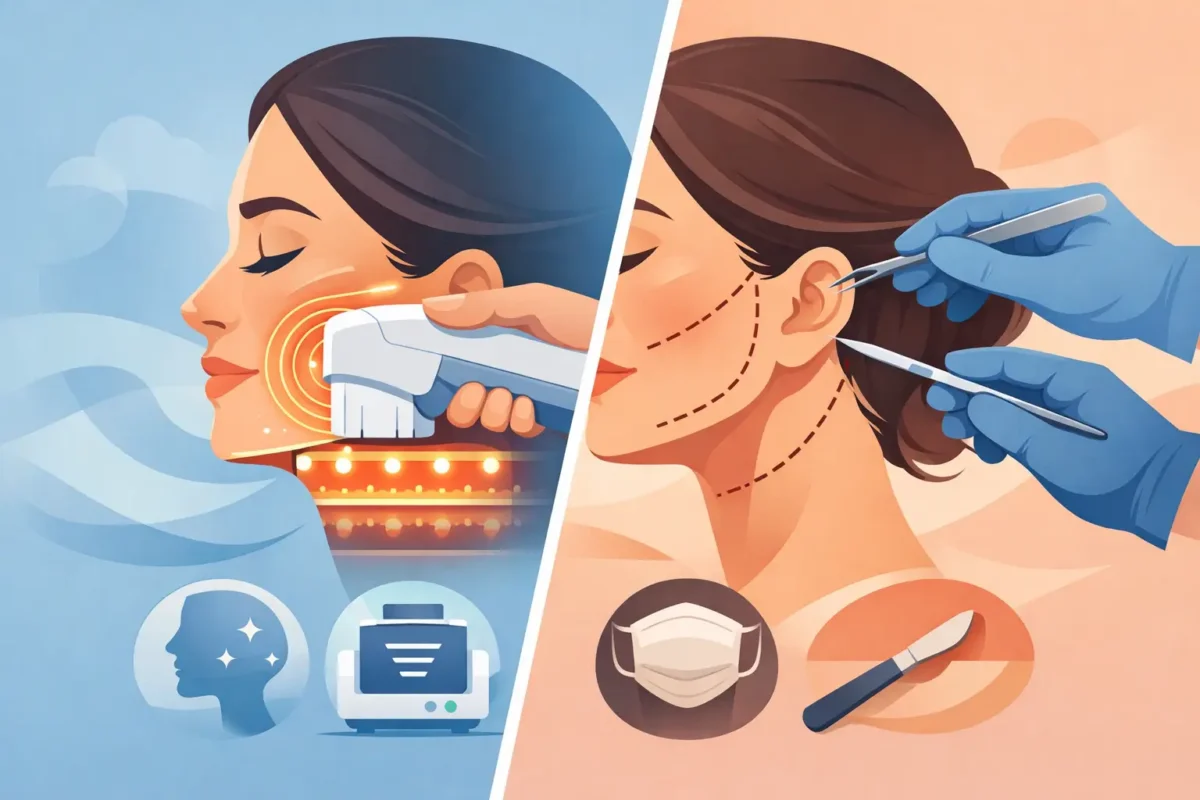
If you are looking in the mirror and noticing sagging around the jawline, cheeks, or neck, the real question is not just what works. It is what kind of result you want to see, how quickly you want to see it, and how much downtime you are willing to accept. When people compare HIFU vs facelift results, they are usually weighing a non-surgical refresh against a more dramatic surgical change.
Both options can improve facial laxity, but they do not create the same kind of transformation. HIFU is designed to stimulate collagen deep under the skin and gradually tighten mild to moderate looseness. A facelift physically repositions tissue and removes excess skin, which can create a much stronger lifting effect. The best choice depends on your starting point, your goals, and how comfortable you are with recovery, cost, and maintenance.
HIFU vs facelift results: the core difference
The simplest way to understand HIFU vs facelift results is this: HIFU improves, while a facelift restructures. HIFU uses focused ultrasound energy to heat deeper layers of tissue and trigger collagen remodeling. The skin can look firmer, slightly lifted, and more defined over time, especially around the lower face and under the chin.
A facelift works at a different level. Surgery allows a provider to lift underlying facial structures, tighten deeper support layers, and remove loose skin. That usually leads to a more visible correction of jowls, deep folds, and significant laxity in the mid-face and neck.
This is why expectations matter so much. HIFU can be an excellent treatment for someone who wants natural-looking tightening without surgery. It is not meant to reproduce the result of a surgical facelift. If a patient expects that level of change, they are often disappointed, not because HIFU failed, but because the wrong treatment was chosen for the goal.
Where HIFU can look impressive
HIFU tends to shine in patients with early to moderate signs of aging. If the skin is starting to loosen but still has decent elasticity, collagen stimulation can create a fresher and more refined look. The improvement is often most noticeable along the jawline, under the chin, and in the upper neck. Some patients also see a subtle brow lift or smoother skin texture over time.
What makes HIFU appealing is that the change can look very natural. Friends may notice you look more rested or a little tighter, but not obviously treated. For many beauty-conscious clients, that is exactly the point. They want visible improvement without taking time off or committing to surgery.
Age alone does not determine whether HIFU will work well. Skin quality, degree of laxity, facial anatomy, and collagen reserves all matter. A healthy patient in their 50s with mild sagging may see a better response than someone younger with more advanced tissue descent. Treatment planning should always be based on the face in front of you, not just the birth date.
Where facelift results go further
A facelift generally produces stronger and more predictable lifting. If the cheeks have dropped, the jawline has blurred, and the neck has visible excess skin, surgery is often the only option that can create a major correction. This is especially true when skin laxity is advanced.
The reason facelift results go further is mechanical. Tissue is physically elevated and secured rather than encouraged to tighten gradually on its own. That makes surgery better suited for patients who want sharper contour, more dramatic rejuvenation, or correction that collagen stimulation alone cannot achieve.
That said, surgery also comes with trade-offs. Recovery is longer, bruising and swelling are expected, and the cost is much higher. There is also the emotional side of surgery. Some patients simply do not want an operation, even if they are technically good candidates. For them, a non-surgical option with moderate improvement may still feel like the better decision.
How long results last
Longevity is another major part of the HIFU vs facelift results conversation. HIFU results build gradually over two to three months, sometimes longer, as collagen develops. The outcome is not permanent, because the aging process continues. Many patients maintain their improvement with repeat treatments, often yearly depending on how their skin responds.
A facelift lasts longer. While it does not stop aging, the structural repositioning tends to hold for years rather than months. Most patients still benefit from maintenance treatments after surgery because skin quality, pigmentation, and fine lines continue to change over time. In other words, a facelift can reset facial contours, but it does not replace good skin care or ongoing aesthetic maintenance.
For some people, HIFU fits better because they prefer gradual, lower-commitment upkeep. Others would rather invest once in a larger correction and enjoy a longer-lasting result. Neither mindset is wrong. It comes down to personal preference, budget, and goals.
Downtime, comfort, and convenience
This is where HIFU often wins. A typical HIFU session involves little to no downtime. Some patients notice temporary redness, mild swelling, or tenderness, but most return to normal activity quickly. That makes it attractive for busy adults who want skin tightening without pressing pause on work, social plans, or family life.
A facelift requires real recovery. Even when healing goes smoothly, patients need time for swelling, bruising, and follow-up care. There may also be temporary numbness, tightness, and activity restrictions. If convenience is a top priority, HIFU has a clear advantage.
Comfort is more mixed. HIFU can feel intense in certain areas because energy is being delivered at depth, although treatment is short and manageable for most people. A facelift involves anesthesia and post-procedure healing, so while the surgery itself is controlled, the overall experience is more involved.
Cost versus value
HIFU is more affordable upfront than a facelift, which is one reason it appeals to patients seeking smart, non-surgical skin tightening. But affordability should be viewed over time. If you need repeat HIFU sessions to maintain results, the long-term investment can add up.
A facelift costs significantly more at the start, yet it may offer greater value for someone with advanced aging who would otherwise spend years chasing a surgical-level result through non-surgical treatments that cannot quite deliver it.
This is where honest consultation matters. The most cost-effective option is not always the cheapest one. It is the treatment that actually matches the level of correction you need.
Who usually gets the best HIFU results
Patients who tend to be happiest with HIFU usually have mild to moderate skin laxity, realistic expectations, and a preference for natural-looking change. They are often not ready for surgery, do not want scars or anesthesia, and are comfortable waiting for gradual improvement. HIFU can also make sense for younger patients who want to stay ahead of sagging rather than reverse heavy tissue descent.
It can also be a strong fit for patients who want to support their overall facial rejuvenation plan. In a clinic setting focused on the science of smart skin, HIFU is often part of a broader strategy that may also include treatments for texture, pigmentation, redness, or volume loss. Tightening is only one part of a refreshed appearance.
Who is usually better served by a facelift
Patients with heavy jowling, pronounced neck laxity, or significant lower-face sagging are usually better served by surgery if their goal is a visible lift. The same is true for patients who feel they already look older in a way that non-surgical treatments only soften around the edges.
There is no prize for avoiding surgery if surgery is the treatment that fits your anatomy and expectations. The best aesthetic decision is the one that gives you a result you can actually feel good about. For some, that means embracing a surgical option. For others, it means choosing a non-invasive treatment that respects their lifestyle and comfort level.
The real question to ask
Instead of asking which treatment is better in general, ask which result would make you happy. Do you want subtle tightening and gradual improvement with little downtime? HIFU may be a very smart choice. Do you want a more dramatic lift that addresses deeper sagging? A facelift will likely deliver more.
A reputable provider should not try to force every patient into the same lane. They should look at your skin, your facial structure, your timeline, and your tolerance for downtime, then guide you toward the option that makes sense. At Bloom Laser Clinic, that kind of individualized thinking is central to creating visible results without overselling what any single treatment can do.
The best treatment is the one that matches your face, not the trend. When your plan is built around realistic outcomes, you are far more likely to see a result that feels beautiful, believable, and worth it.