


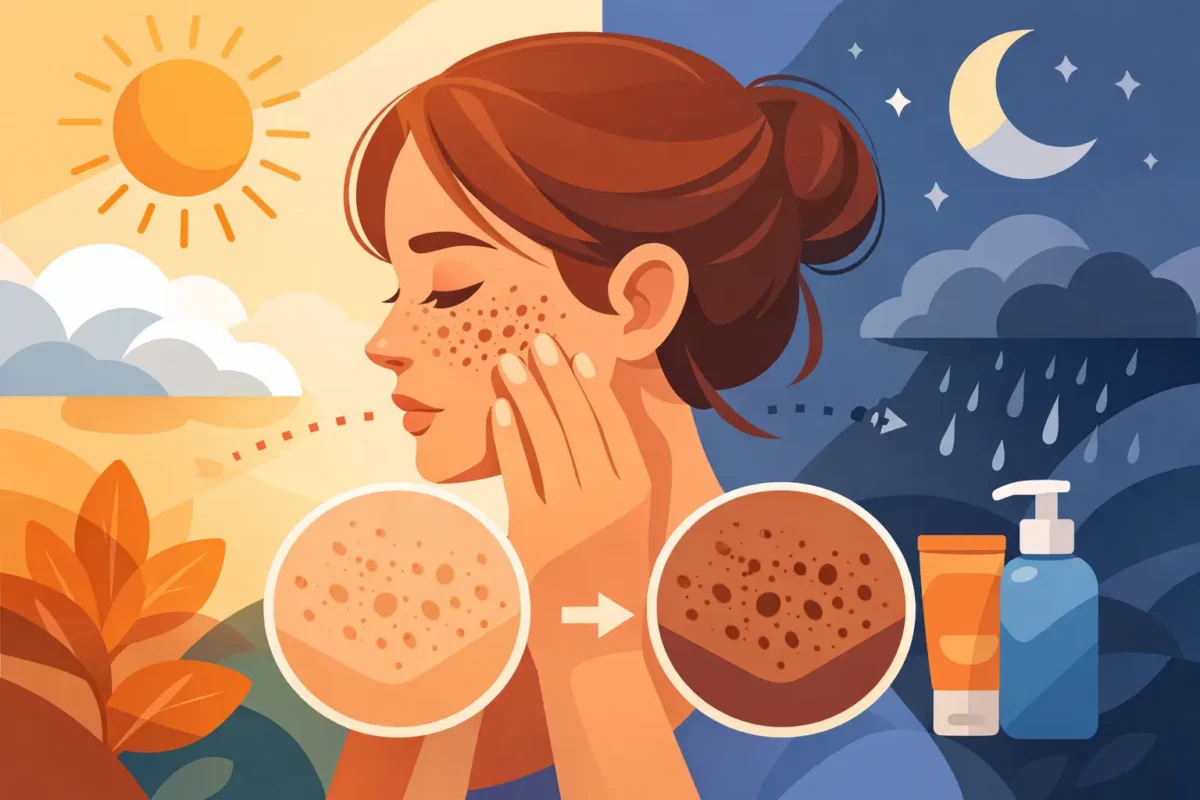
You catch your reflection one morning and a freckle that usually blends in suddenly looks deeper, sharper, or more noticeable. If you are wondering why freckles get darker suddenly, the short answer is that pigment cells respond quickly to triggers like UV exposure, hormones, heat, irritation, and age-related skin changes.
That does not always mean something is wrong. In many cases, freckles darken because your skin is doing exactly what it is designed to do – produce more pigment when it feels stressed or stimulated. Still, sudden pigment changes deserve a closer look, especially if one spot starts behaving differently from the rest.
Why freckles get darker suddenly in the first place
Freckles are small areas of concentrated melanin, the pigment that gives skin its color. People who freckle easily tend to have pigment cells that are especially responsive to sunlight. Even a modest amount of UV exposure can trigger those cells to produce more melanin, which makes freckles appear darker.
That response can happen faster than many people expect. A weekend outdoors, a few sunny commutes, or even sitting near a bright window repeatedly can be enough to deepen existing freckles. This is especially common in spring and summer, when incidental sun exposure adds up.
Freckles also do not all respond the same way. Some stay stable for years. Others darken and fade with the seasons. If several freckles deepen at once, a trigger like sun or heat is often the most likely reason. If one mark changes while the others remain the same, it is worth paying closer attention.
The most common reason: sun exposure
The biggest driver of darker freckles is UV light. Sun exposure stimulates melanocytes, and freckles are one of the clearest visible signs of that activity. You do not need a sunburn for this to happen. Daily, low-level exposure is often enough.
This is why freckles can seem to darken suddenly after a beach day, a vacation, or even a stretch of bright weather. It can also happen after tanning, whether outdoors or in a tanning bed. If your skin is prone to pigmentation, UV exposure tends to bring it forward quickly.
There is a trade-off here. Some people love the look of freckles and want to keep them visible, while others feel their complexion starts looking uneven when freckles darken too much. The goal is not always to erase pigment. Often, it is to keep it from becoming patchy, excessive, or harder to manage over time.
Heat and inflammation can make pigment look stronger
Sun is not the only factor. Heat can also make freckles appear darker, especially in skin already prone to pigmentation. Hot yoga, steam rooms, long hot showers, or spending time in humid weather can all contribute. Heat increases inflammation in the skin, and inflammation can stimulate pigment production.
This is one reason some people notice more discoloration in summer even when they have been careful with sunscreen. Their skin is reacting not only to UV exposure, but also to temperature and vascular activity.
Inflammation from other causes can have a similar effect. An irritated breakout, over-exfoliation, harsh products, or friction from repeated rubbing can leave the skin more reactive. In pigmentation-prone skin, that reactivity sometimes makes freckles and nearby spots look darker or more pronounced.
Hormones can shift pigmentation quickly
Hormonal changes are another common answer to why freckles get darker suddenly. Pregnancy, birth control, hormone replacement therapy, and natural hormonal fluctuations can all influence melanin production. In some people, freckles become more noticeable. In others, broader patches of discoloration develop, often looking more like melasma than classic freckles.
This matters because not every brown spot is actually a freckle. A spot that seems like a suddenly darkened freckle may be sun damage, lentigo, post-inflammatory pigmentation, or melasma starting to emerge. They can look similar at first, but they do not always behave the same way or respond to the same treatment.
If pigment changes coincide with a medication change, pregnancy, or a noticeable hormonal shift, that context is useful. It does not automatically make the change harmless, but it does help explain why it may be happening.
Age and cumulative sun damage can change the picture
Freckles are often associated with youth, but pigment changes usually become more complex with age. Over time, repeated sun exposure can lead to solar lentigines, often called sun spots or age spots. These are not exactly the same as freckles, even though many people use the terms interchangeably.
Freckles tend to darken with sun and lighten when sun exposure decreases. Lentigines are more persistent. They may appear suddenly because you only recently noticed them, but they are often the result of cumulative UV damage built up over years.
This is where professional assessment becomes valuable. If your “freckles” are multiplying, deepening, or no longer fading the way they once did, the issue may be broader pigmentation rather than simple seasonal freckling.
When a darkening freckle is worth checking
Most darkening freckles are benign, but some changes should not be brushed off. A spot deserves evaluation if it becomes noticeably asymmetric, develops an irregular border, changes into multiple colors, grows quickly, or starts itching, bleeding, or crusting.
The same goes for a single spot that looks very different from the others. Dermatology professionals sometimes call this the ugly duckling sign – one lesion that stands out because it does not match your usual pattern. That does not mean it is dangerous, but it does mean it should be examined.
There is an important balance here. You do not need to panic every time a freckle darkens after sun exposure. But you also should not assume every pigment change is cosmetic. A skin check is the right next step whenever a spot looks unusual, evolves rapidly, or simply feels off to you.
Can skin care make freckles darker?
Indirectly, yes. Certain products and treatments can make skin more photosensitive, which means UV exposure has a greater effect. Retinoids, exfoliating acids, and some prescription treatments can leave skin more vulnerable if sun protection is not consistent.
That does not make these ingredients bad. In fact, many are excellent for skin renewal and pigment management when used correctly. The issue is usually the combination of active skin care and inadequate sun protection. If you are treating your skin aggressively but skipping daily SPF, freckles and other pigment can become more obvious.
Fragrance irritation, overuse of scrubs, and picking at the skin can also create inflammation that encourages uneven pigment. Sometimes what looks like darker freckles is actually a mix of freckles and post-inflammatory discoloration sitting side by side.
What you can do if freckles are getting darker
Start with the basics. Daily broad-spectrum sunscreen is the single most useful step if your goal is to prevent freckles from deepening. Reapplication matters, especially during outdoor time, driving, and days with reflective surfaces like water or snow.
Beyond sunscreen, physical barriers help more than people think. Hats, sunglasses, and shade reduce cumulative exposure in a way skin care alone cannot. If heat seems to worsen your pigmentation, cooling the skin and avoiding unnecessary thermal triggers can also help.
For cosmetic improvement, treatment depends on what the spots actually are. Freckles, sun spots, and melasma may all require different approaches. Topical brightening ingredients can be helpful, but professional options often deliver more visible change when pigmentation has become stubborn or widespread.
Clinics that focus on pigment correction and laser-based skin rejuvenation can assess whether you are dealing with simple freckling, sun damage, or a more complex pigmentation pattern. At Bloom Laser Clinic, this kind of evaluation is part of the science of smart skin – matching the treatment to the biology of the pigment rather than guessing based on appearance alone.
That said, not every darkened freckle should be treated cosmetically right away. If a spot is changing in a concerning way, medical evaluation comes first. Once your skin has been properly assessed, aesthetic treatment can be considered safely and strategically.
Why timing matters with pigmentation
Pigment is often easier to manage early, before it becomes more entrenched. Repeated UV exposure can make freckles darker, then gradually push the skin toward a more uneven background tone overall. What starts as a few deeper freckles can become diffuse discoloration that is harder to fade.
This is why people often feel that their skin “changed all at once,” even when the process has been building for months or years. The visible shift may seem sudden, but the underlying triggers have usually been accumulating quietly.
If your freckles look darker than usual, take it as useful information. Your skin may be telling you it is getting more UV exposure than you realized, reacting to hormonal shifts, or becoming more pigmentation-prone with time. Paying attention early gives you more control over what happens next.
Freckles can be beautiful, and darker freckles are often just a sign of increased pigment activity, not a problem. But when a spot changes in a way that feels different, trust that instinct and get it checked. The smartest approach is not fear – it is clarity, protection, and choosing skin care decisions that support healthy, even-toned skin for the long term.