


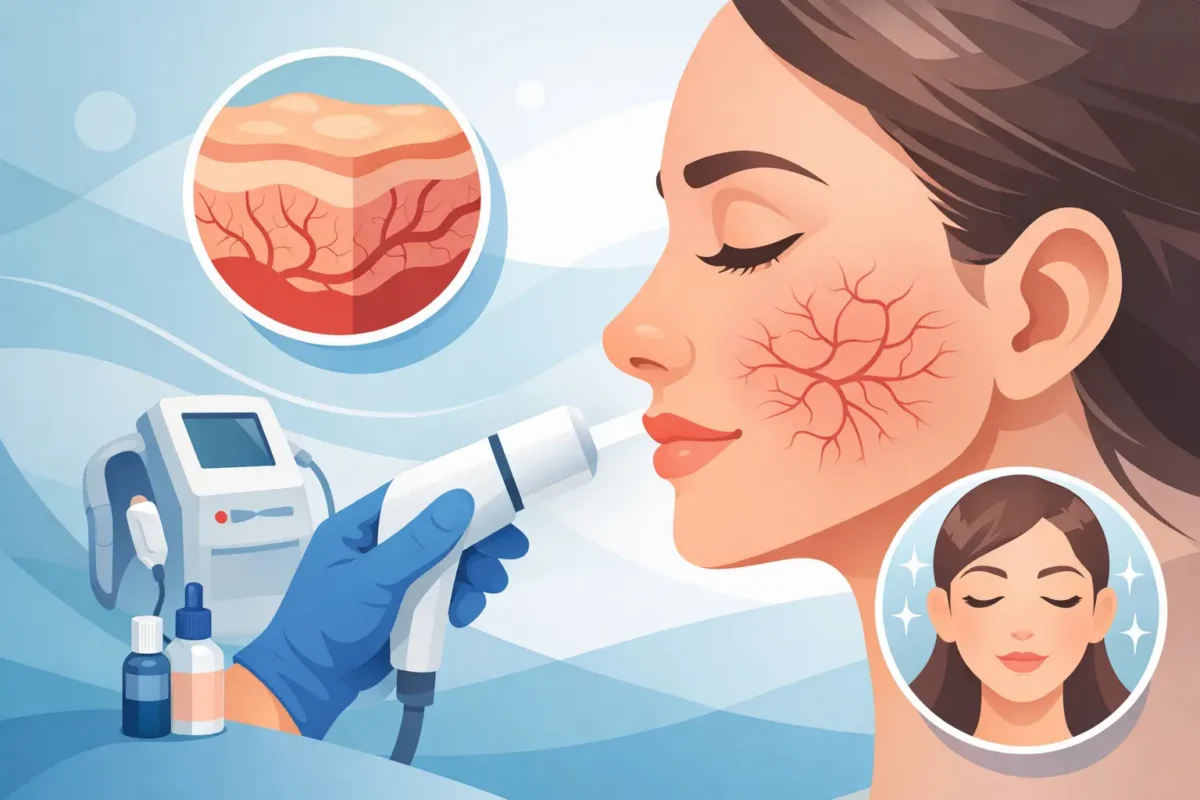
If broken capillaries around your nose or cheeks make your skin look constantly flushed, makeup can only do so much. Treating facial veins without surgery has become one of the most effective ways to reduce visible redness and restore a clearer, more even-looking complexion without the downtime of invasive procedures.
Why facial veins become more visible
Facial veins often show up as thin red, blue, or purple lines near the nose, across the cheeks, or on the chin. They can appear gradually or seem to arrive all at once after years of sun exposure, heat, wind, or irritation. For many people, genetics also play a major role. If your skin tends to flush easily or you have rosacea, visible veins may be more likely.
The reason they stand out is simple. Tiny blood vessels near the surface of the skin become enlarged and stay that way. Once a vessel has stretched and remains visible, creams and home remedies usually cannot make it disappear. Skincare may help calm surrounding redness, but it does not remove the vessel itself.
That is where in-office treatment becomes the better option. The goal is not to cut, strip, or surgically remove anything. Instead, modern technologies target the visible vessel through the skin while protecting the surrounding tissue as much as possible.
Treating facial veins without surgery: what actually works
When people ask about treating facial veins without surgery, they are usually looking for something that is effective, safe, and realistic for everyday life. In most cases, laser and light-based treatments are the leading options because they are designed to target hemoglobin in the blood vessel. The energy heats the vessel, causing it to collapse and gradually be absorbed by the body.
This approach works especially well for small superficial veins, scattered broken capillaries, and redness associated with rosacea. It is precise, fast, and much easier to fit into a busy schedule than a surgical procedure would be.
Not every visible vein responds the same way, though. Very fine red vessels, larger blue veins, and diffuse redness can behave differently. Skin tone, skin sensitivity, and the depth of the vessel also matter. That is why a proper assessment matters more than chasing the newest device name.
Laser treatment for facial veins
Laser treatment is often the first recommendation for facial veins because it can selectively target unwanted vessels with minimal disruption to the skin around them. During treatment, pulses of energy are delivered to the affected area. Patients often describe the feeling as a quick snap of heat against the skin.
The biggest advantage is precision. A trained provider can focus on the vessels that bother you most while tailoring settings to your skin type and comfort level. This matters on the face, where the skin is highly visible and the margin for error is small.
Results can be impressive, but they are not always instant. Some vessels fade right away. Others darken first, then slowly clear over several weeks. It is common to need a series of sessions for the best cosmetic outcome, especially if the redness has built up over time.
IPL and redness-focused light treatments
For clients dealing with both visible veins and more generalized redness, intense pulsed light can sometimes be a strong option. IPL is not exactly the same as a laser. It uses broad-spectrum light rather than a single wavelength, which can make it useful for treating overall redness, sun damage, and uneven tone at the same time.
This can be appealing if your concern is not just a few broken capillaries, but a face that looks persistently pink or reactive. The trade-off is that IPL is not ideal for every vein type, and it may not be the best choice for every skin tone. In some cases, a vascular-specific laser gives more precise vessel clearance.
When vein injections are not the first choice
People sometimes hear about sclerotherapy for spider veins on the legs and wonder if the same treatment is used on the face. Generally, facial veins are approached differently. Because facial anatomy is more delicate and visible, laser-based treatment is often preferred over injectable vein treatment for this area.
That does not mean every facial vessel is simple to treat. Larger veins around the eyes or temples may require a more individualized plan. This is one of those areas where experience matters.
Who is a good candidate?
Most healthy adults with visible superficial facial veins can be candidates for treatment, but candidacy depends on more than whether a vessel is visible. Your provider should consider your skin type, recent sun exposure, medications, tendency to pigment, history of rosacea, and whether your redness is mostly vascular or partly inflammatory.
The best candidates are usually those with realistic expectations. Non-surgical treatment can significantly reduce visible veins and redness, but it may not make the skin look poreless or perfectly uniform. If you continue to experience triggers like heat, alcohol, spicy food, sun exposure, or harsh exfoliation, new veins can still form over time.
In other words, treatment clears existing visible vessels. It does not stop your skin from being genetically prone to flushing or sensitivity.
What to expect during and after treatment
A consultation usually comes first. This is where your skin is examined under proper lighting, your medical history is reviewed, and a treatment plan is built around your goals. A physician-led or clinically supervised setting offers extra reassurance because visible redness can sometimes overlap with rosacea, sun damage, or other skin conditions.
The treatment itself is often quite quick. Small areas may take only a few minutes, while more widespread redness can take longer. Protective eyewear is typically worn, and cooling may be used to improve comfort.
Afterward, mild redness and swelling are common. Some vessels may temporarily look darker or more pronounced before they fade. Most people return to normal activity quickly, but there are a few short-term restrictions. Skin should be protected from heat, intense exercise, hot baths, and direct sun for a period recommended by your provider.
Downtime is usually minimal, which is one reason these treatments are so popular. Still, minimal downtime does not mean no aftercare. Good healing supports better results.
How many sessions will you need?
This depends on the number of vessels, their size, how long they have been present, and the technology used. A few isolated capillaries may respond in one session. More commonly, a series of treatments is recommended.
Rosacea-related redness often needs more than one appointment because the issue is not just one vessel. It is a broader vascular pattern in the skin. Improvement tends to build gradually, which can actually be reassuring. The change often looks natural rather than abrupt.
Maintenance can also be part of the plan. If your skin is prone to recurring redness, occasional follow-up treatments may help preserve the result.
Choosing the right provider for treating facial veins without surgery
This is not a treatment to bargain-shop based on price alone. The face requires a careful eye, proper technology, and a provider who understands vascular lesions, skin response, and cosmetic balance. You want someone who can tell the difference between a quick-fix promise and a treatment plan that truly fits your skin.
A strong consultation should include a realistic discussion of expected clearance, possible side effects, and whether your redness may be linked to rosacea or another underlying trigger. The right clinic will not promise perfection. It will explain how treatment works, what result is likely, and why your plan may differ from someone else’s.
For patients in Atlantic Canada, choosing a clinic with experience in non-invasive skin treatments can make the process feel more approachable. At Bloom Laser Clinic, the focus is on advanced aesthetic technology guided by clinical judgment, so clients can pursue clearer skin with confidence rather than guesswork.
Small habits that help your results last longer
Even the best laser result benefits from smart maintenance. Daily sunscreen matters because UV exposure weakens skin support structures and encourages ongoing redness. Gentle skincare also matters more than many people realize. Over-cleansing, frequent exfoliation, and active-heavy routines can keep sensitive skin in a reactive state.
If you know your triggers, managing them helps. That might mean reducing extreme heat exposure, protecting your face in windy weather, or being more selective with alcohol and spicy foods if they consistently cause flushing. You do not have to live cautiously to protect your skin, but awareness makes a difference.
Visible facial veins can make skin look irritated, older, or uneven even when it is otherwise healthy. The good news is that modern non-surgical treatment can do far more than cover the problem. With the right technology and an experienced plan, clearer-looking skin is a realistic goal, and often much closer than people think.