


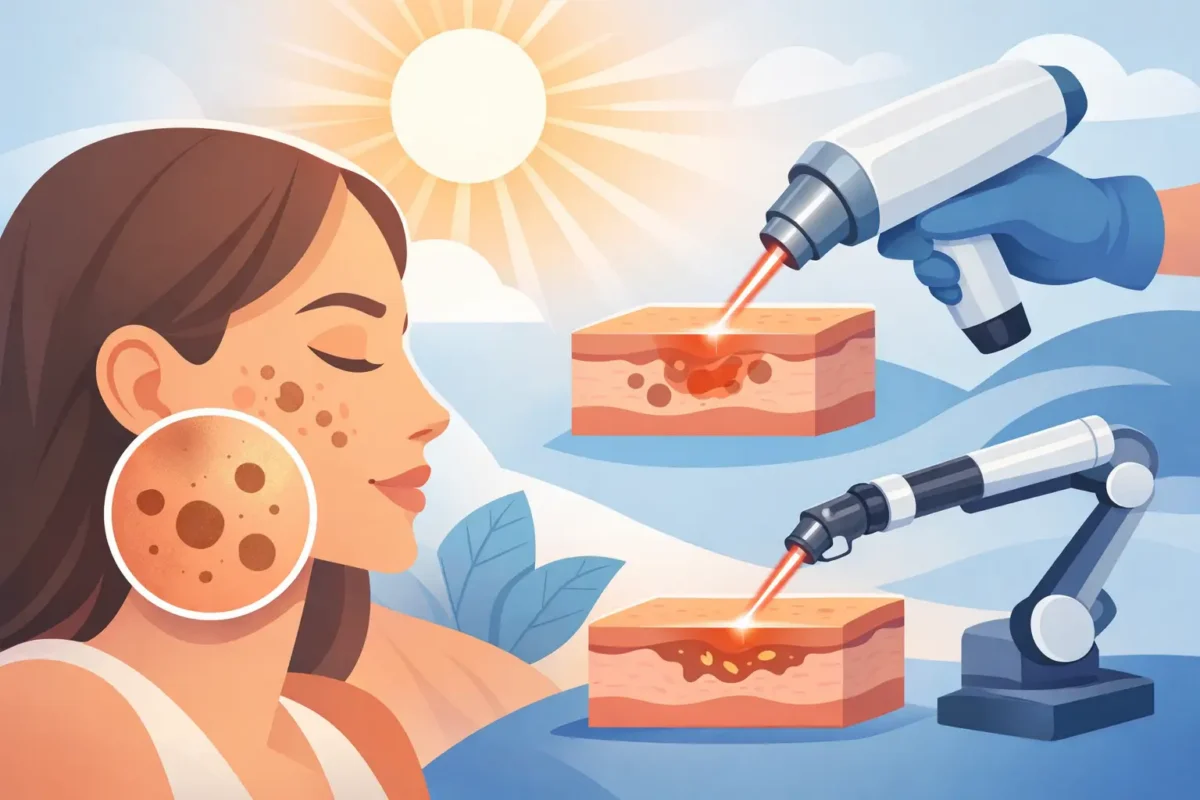
A few summers ago, that light sprinkling of pigment across your cheeks may have looked like a healthy glow. Then one day it stops reading as fresh and starts reading as uneven. That is usually the moment people begin searching for sun spots laser treatment options – not because they want perfection, but because they want their skin tone to look clear, polished, and like itself again.
Sun spots are one of the most common pigmentation concerns treated in aesthetic clinics. They tend to show up on the face, chest, shoulders, and hands after years of UV exposure, and they often become more visible with age. The good news is that many respond very well to laser-based care. The less simple part is choosing the right device, the right treatment plan, and the right expectations for your skin.
What sun spots actually are
Sun spots, also called solar lentigines or age spots, are areas where pigment-producing cells have become more active after repeated sun exposure. They are usually flat, tan to dark brown, and sharply defined. Unlike freckles, which can fade when sun exposure drops, sun spots often linger and gradually multiply over time.
Not every dark mark is a sun spot, though. Melasma, post-inflammatory hyperpigmentation, and certain benign lesions can look similar at a glance. That matters because the wrong treatment can underperform or even make some pigment conditions worse. A proper skin assessment is where smart treatment starts.
Why laser treatment is often the best fit
Topical brightening products can help lighten mild discoloration, but established sun damage often sits deeper and responds more slowly. Laser energy targets excess pigment more directly, helping the body break it up and clear it away. For many patients, that means faster, more visible improvement than creams alone.
Still, laser is not one single approach. Different technologies work in different ways. Some target pigment very precisely with little downtime. Others treat both discoloration and texture, which can be useful if sun damage has also left the skin dull, rough, or uneven.
Sun spots laser treatment options to know
When patients ask about sun spots laser treatment options, they are usually really asking three things: What works best, what will recovery look like, and what is safest for my skin tone. The answer depends on the type of pigment, your baseline complexion, and how aggressive you want to be.
Q-switched and picosecond lasers
These lasers are commonly used for pigmentation because they deliver energy in very short bursts that target melanin without heavily heating surrounding tissue. That makes them a strong option for discrete brown spots and uneven sun-induced pigment.
A major advantage is precision. In many cases, the treated spots darken first, then flake or fade over the following days. Downtime is often limited, although the skin can look temporarily bronzed or mildly irritated. Multiple sessions may be recommended depending on how dense the pigment is and how much overall brightening you want.
Picosecond devices can be especially appealing for patients who want efficient pigment breakup with a modern, technology-forward approach. They are not automatically the right answer for everyone, but they are often part of a high-quality pigment treatment menu for a reason.
Nd:YAG laser treatments
Certain Nd:YAG platforms are versatile and widely used in medical aesthetics for pigment correction. Depending on settings and wavelength, they can treat sun spots while also supporting broader skin rejuvenation goals.
This category is often useful when a practitioner wants flexibility. Some patients have isolated spots. Others have background redness, uneven tone, enlarged pores, or textural sun damage that may benefit from a more customized plan. A physician-led or medically supervised clinic can adjust the approach based on what your skin actually needs rather than forcing one device to do every job.
Fractional laser resurfacing
If your concern goes beyond a few brown spots and includes rough texture, fine lines, or a generally weathered look, fractional resurfacing may be worth discussing. These treatments create controlled micro-injury in the skin to stimulate renewal, and some systems can improve both pigmentation and texture.
The trade-off is downtime. Compared with targeted pigment lasers, resurfacing usually involves more redness, peeling, and aftercare. It can deliver impressive rejuvenation, but it is not always the first choice for someone who simply wants a few sun spots lifted before a busy week.
IPL versus true laser treatment
Although IPL is not technically a laser, it often comes up in the same conversation because it can treat visible sun damage effectively. IPL uses broad-spectrum light rather than a single laser wavelength, and it can work well for diffuse discoloration, redness, and overall photoaging.
For some patients, IPL is a practical choice. For others, a true pigment laser is better for precision or safety. Skin tone is especially important here, since not every light-based treatment is ideal for every complexion. That is why treatment should be selected by skin type and diagnosis, not by trend.
Which option is best for your skin tone
This is where nuance matters. Fairer skin tones with clearly defined brown sun spots often have several effective laser and light-based options. Deeper skin tones can absolutely be treated too, but the plan should be chosen with more caution to reduce the risk of post-inflammatory hyperpigmentation.
An experienced provider will consider your Fitzpatrick skin type, your tanning history, whether the pigment is epidermal or deeper, and whether there is any chance the issue is melasma rather than a true sun spot. Aggressive treatment is not always better. Safer, staged improvement is often the better route when protecting skin clarity is the priority.
What treatment feels like and what happens after
Most pigment-focused laser sessions are very manageable. Patients often describe the sensation as a quick snapping or warming feeling. Depending on the device and treatment area, cooling, topical numbing, or both may be used to keep you comfortable.
After treatment, the skin may look pink or slightly swollen. Pigmented spots often darken before they lighten, which is normal and usually means the pigment has been successfully targeted. Over the next several days, those spots can take on a coffee-ground look and gradually shed.
Sun protection is non-negotiable. Freshly treated skin is more vulnerable, and UV exposure can interfere with results or trigger new discoloration. Daily sunscreen, shade, and a pause on unnecessary heat exposure are part of the treatment, not an optional extra.
How many sessions you may need
Some sun spots improve dramatically after one session. Others need a series. If the pigment is dense, widespread, or layered with other concerns like redness or textural damage, your provider may recommend a phased plan rather than trying to correct everything at once.
This is often where expectations need a reset. Laser can deliver beautiful improvement, but it does not erase your history of sun exposure in one visit. The goal is clearer, more even-looking skin with a treatment plan that respects skin health.
Cost factors patients should understand
Pricing varies based on the technology used, the size of the treatment area, the number of sessions required, and the level of provider expertise. A single small spot treatment will not be priced the same way as full-face pigment correction with advanced laser technology.
The lowest price is not always the best value. When pigment is misidentified or treated with the wrong settings, patients can end up paying again to fix avoidable problems. Skilled assessment, appropriate technology, and follow-up guidance matter just as much as the laser itself.
When laser may not be the first step
There are situations where treating sun spots right away is not ideal. If you are very tanned, recently had intense sun exposure, are prone to pigment rebound, or have active skin irritation, your provider may advise waiting or preparing the skin first. Sometimes topical care is used before laser to calm inflammation or reduce the risk of uneven healing.
And if the lesion has an unusual shape, color variation, or any concerning features, medical evaluation comes before aesthetics. A reputable clinic will always put safety first.
Getting better results that last
The best laser outcomes do not come from the device alone. They come from accurate diagnosis, customized settings, and the habits that follow treatment. Sunscreen is the obvious one, but consistency matters more than good intentions. If UV exposure continues unchecked, new spots will eventually form.
Maintenance can also be part of the plan. Some patients do one corrective series and then occasional touch-ups. Others combine pigment treatment with gentle rejuvenation treatments to keep tone, clarity, and texture looking fresh. At Bloom Laser Clinic, this kind of tailored planning is part of the science of smart skin – treating what is visible today while protecting the confidence you want to keep tomorrow.
If sun spots have started to make your skin look older or less even than you feel, laser treatment can be a very effective next step. The right option is the one that fits your pigment, your skin tone, your schedule, and your goals – because beautiful results should look natural, not forced.