


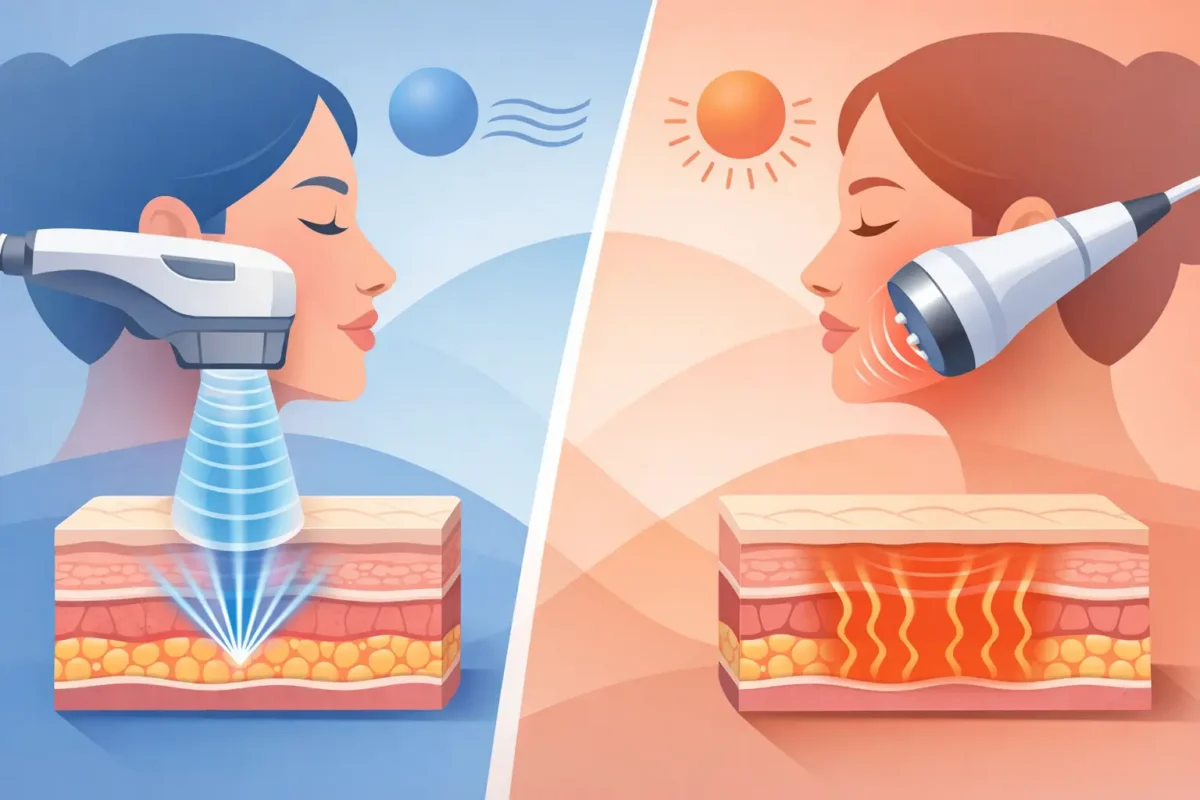
When your skin starts to feel a little less firm, the question usually is not whether you want improvement – it is which treatment makes the most sense. In the HIFU vs RF skin tightening conversation, the right answer depends on what you want to lift, how quickly you want to see change, and how much downtime or discomfort you are willing to accept.
Both treatments are popular because they offer a non-surgical path to firmer, smoother-looking skin. Both can improve facial contours and help soften the early signs of aging. But they do not work in the same way, and they do not target the same skin depth. That difference matters if your goal is a sharper jawline, smoother cheeks, tighter skin around the lower face, or a more refreshed look overall.
HIFU vs RF skin tightening: the core difference
HIFU stands for high-intensity focused ultrasound. It delivers ultrasound energy deep below the skin surface, reaching structural layers that are typically associated with skin support and lifting. The goal is to trigger collagen production at a deeper level, which can gradually improve firmness and contour over time.
RF stands for radiofrequency. It uses controlled heat to warm tissue in the more superficial to mid-level layers of the skin, depending on the device being used. That thermal stimulation encourages collagen remodeling and can improve skin texture, mild laxity, and overall smoothness.
The simplest way to think about it is this: HIFU is often chosen when lifting and deeper tightening are the priority, while RF is often favored when the focus is surface-level firmness, texture, and a gentle tightening effect. Neither is automatically better. It depends on the concern being treated and the result you want to see in the mirror.
How HIFU works
HIFU sends focused ultrasound energy into precise depths of tissue without damaging the skin surface. That energy creates targeted thermal points, which stimulate the body’s natural healing response and new collagen formation. Since the treatment reaches deeper support structures, it is often used for the lower face, jawline, chin area, and neck.
HIFU is commonly recommended for clients who are seeing early to moderate skin laxity but are not ready for surgery. It can be especially appealing if the concern is less about skin texture and more about sagging or softening along the facial contours.
One reason people like HIFU is that results develop gradually. Your skin does not suddenly look different overnight. Instead, it can become firmer and more defined as collagen rebuilds over the following weeks and months. For many clients, that slow progression feels natural and believable.
How RF skin tightening works
RF treatments rely on heat. By warming the dermis, radiofrequency encourages collagen contraction and stimulates fresh collagen production over time. Depending on the technology, RF can be used on the face and body and may be especially useful for crepey skin, mild laxity, and textural concerns.
RF tends to appeal to clients who want a more comfortable treatment experience and a series-based approach. Some RF treatments can produce a short-term plumping effect soon after treatment, with longer-term improvement building through repeated sessions. Skin can look smoother and feel firmer, especially when mild looseness is paired with uneven texture.
Because RF works closer to the surface than HIFU, it can be a strong option for clients who are not dealing with significant sagging but want prevention, refinement, and steady maintenance.
Which treatment gives better lifting?
If lifting is your main goal, HIFU usually has the stronger case. Its ability to target deeper support layers makes it better suited for areas where definition has started to fade, especially around the jawline and under the chin. When a client says, “I want my lower face to look tighter,” HIFU is often part of that conversation.
That said, lifting has limits in any non-surgical treatment. If skin laxity is advanced, neither HIFU nor RF will replicate a surgical facelift. A good provider should be honest about that. The best outcomes happen when the treatment matches the degree of laxity rather than trying to force a technology to do more than it can.
RF can still improve firmness, but its effect is generally subtler in terms of lift. It often shines when the skin looks tired, slightly loose, or textured rather than visibly dropping.
Which is better for texture and overall skin quality?
This is where RF often stands out. Because it works in layers that directly affect skin quality, it can improve the look of fine lines, mild laxity, and texture in a way that many clients appreciate. If the skin feels thinner, less springy, or a bit crepey, RF may be more aligned with the goal.
HIFU is less about polishing the surface and more about structural tightening underneath. It can improve the overall appearance of firmness, but it is not usually the first choice if your biggest frustration is texture alone.
For some clients, the most effective strategy is not choosing one forever. It is using the right treatment at the right time, based on what the skin currently needs.
Comfort, downtime, and treatment schedule
Comfort is one of the biggest deciding factors.
HIFU can feel intense in certain areas because it reaches deeper tissue. Sensation varies by person, but clients often describe brief zaps of heat or energy under the skin. Downtime is usually minimal, though mild tenderness or swelling can happen for a short time after treatment.
RF is often considered more comfortable. Many devices create a warm, tolerable sensation, and the appointment can feel easier for clients who are nervous about discomfort. There may be temporary redness, but downtime is usually limited.
The treatment schedule can also differ. HIFU is often performed less frequently, sometimes as a single session with follow-up based on response and skin condition. RF more commonly works as a series, with multiple sessions spaced out to build results. For some people, one stronger treatment is appealing. For others, gradual maintenance fits better into their routine.
HIFU vs RF skin tightening by age and skin concern
Age matters less than skin behavior. A person in their 30s with early lower-face laxity may be a better HIFU candidate than someone older whose main issue is texture. Likewise, a person in their 40s or 50s with mild crepiness and diffuse looseness may love what RF can do.
HIFU may be a stronger fit if you notice softening under the chin, a less defined jawline, or moderate slackness around the lower face and neck. RF may be more appealing if your goals are smoother skin, better elasticity, and a refreshed appearance without the intensity of a deeper-focused treatment.
This is why a consultation matters. Good treatment planning is not about chasing the most talked-about technology. It is about reading the skin properly and choosing the option that fits your anatomy, comfort level, and expectations.
Who is not a great candidate?
Neither treatment is ideal for everyone. Very severe laxity may call for a surgical discussion if the goal is dramatic lifting. On the other end of the spectrum, very mild concerns may respond well to skincare, collagen-stimulating facials, or other less intensive options.
Skin quality, age-related volume loss, and facial structure also influence results. Sometimes what looks like loose skin is actually volume loss in the cheeks or temples. In that case, tightening alone may not create the result you want. This is where an experienced clinic can prevent disappointment by recommending a plan instead of a one-size-fits-all treatment.
So which should you choose?
Choose HIFU if your main concern is deeper laxity and you want more visible lifting potential without surgery. Choose RF if your priorities are comfort, smoother texture, and gradual firming through a treatment series. If you want both structural support and better skin quality, a customized plan may be the smarter move than treating this as a one-or-the-other decision.
At Bloom Laser Clinic, that kind of treatment planning is part of the value of professional care. The best technology still needs the right hands and the right assessment behind it.
A beautiful result usually starts with a simple truth: the best treatment is not the trendiest one. It is the one that fits your skin, your goals, and the version of yourself you want to feel when you look in the mirror.