


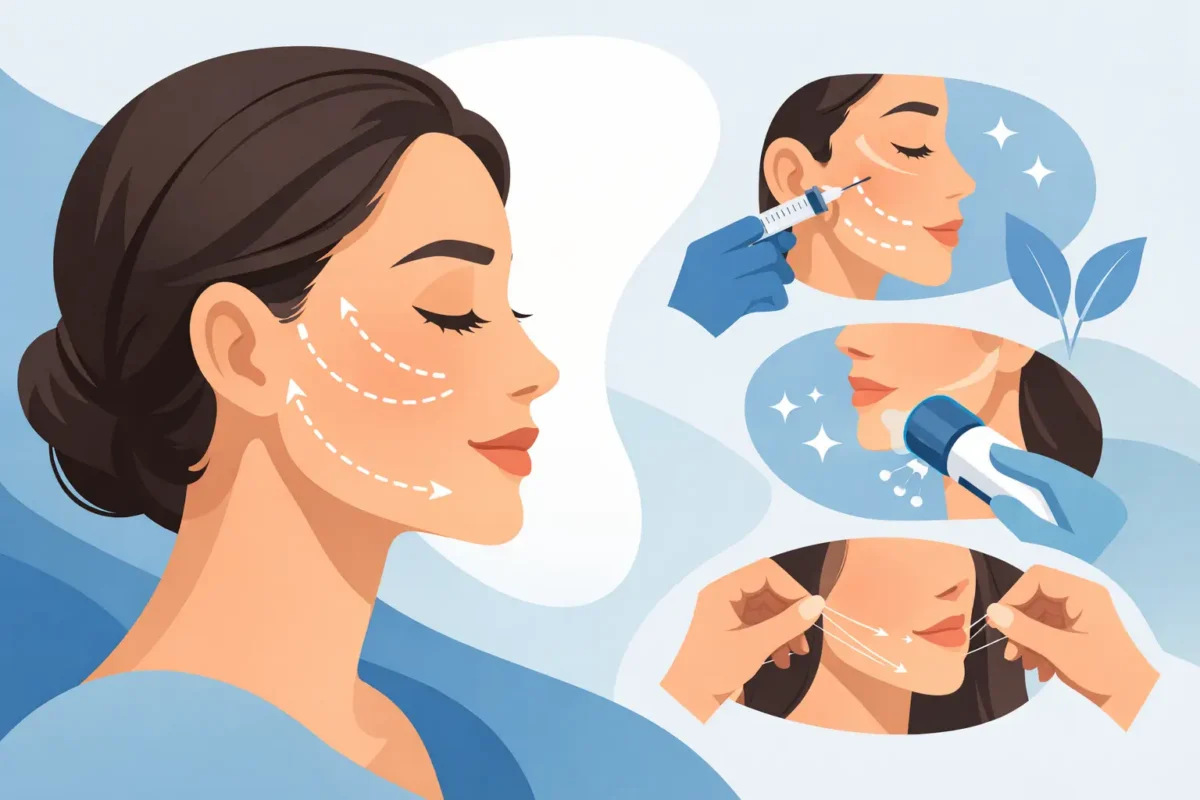
You usually know the moment your reflection starts to feel slightly out of sync with how you feel. The jawline looks softer, the cheeks sit lower, the skin seems less firm, and makeup stops sitting the way it used to. A guide to non surgical facelift options can help you sort through what is actually effective, what delivers subtle improvement, and what makes sense for your face, budget, and comfort level.
The phrase sounds simple, but there is no single treatment called a non-surgical facelift. It is really a treatment strategy. The goal is to lift, tighten, smooth, and refresh the face without incisions, general anesthesia, or the long recovery that comes with surgery. For many people, that is exactly the right fit. For others, it is a powerful way to delay surgery or maintain results over time.
What a non-surgical facelift really means
A non-surgical facelift is usually a customized combination of treatments designed to improve skin laxity, facial contour, and overall facial freshness. Depending on what is bothering you most, that may include HIFU for tightening, injectables for wrinkle softening or volume support, and laser treatments for texture, tone, and radiance.
That distinction matters because facial aging does not happen in one layer. Skin quality changes. Collagen declines. Volume shifts. Muscles pull differently over time. A good treatment plan addresses the right cause instead of trying to force one treatment to do everything.
If your main concern is loose lower-face skin, tightening technology may be the priority. If hollowness is making the face look tired, filler may do more than skin tightening alone. If your skin looks dull, crepey, sun-damaged, or uneven, laser resurfacing or rejuvenation can make the entire result look more polished.
A guide to non surgical facelift treatments
The best-known options each solve a different problem. That is why an experienced provider starts with facial assessment, not a menu.
HIFU for lift and firmness
HIFU, or high-intensity focused ultrasound, is one of the most useful tools for people who want visible tightening without surgery. It works by delivering focused ultrasound energy into deeper structural layers of the skin, where it stimulates collagen remodeling.
This makes HIFU especially appealing for the jawline, lower face, neck, and brows. It does not create the dramatic repositioning of a surgical facelift, but it can create a firmer, more defined look over time. Results tend to build gradually as collagen production increases, so patience is part of the process.
HIFU is often a strong fit for mild to moderate laxity. If skin sagging is more advanced, it may still help, but expectations need to be realistic.
Botox for softening lines and improving balance
Botox is not a lifting treatment in the surgical sense, but it is often part of a non-surgical facelift plan because it changes how the face moves. By relaxing specific muscles, Botox can soften forehead lines, frown lines, and crow’s feet, while also helping reduce downward pull in certain areas of the face.
Used strategically, it can create a fresher, more rested appearance. It is subtle when done well. You still look like yourself, just less tense and less tired.
Dermal fillers for structure and support
Fillers restore volume where age has reduced it. That may mean the cheeks, temples, nasolabial folds, marionette lines, or jawline. The idea is not to make the face bigger. The best filler work supports facial structure so the face looks balanced and gently lifted.
This is where technique matters enormously. Too much filler, or filler placed in the wrong area, can make the face look heavy instead of refreshed. Done thoughtfully, it can soften shadows, support sagging tissue, and improve contour in a way that feels elegant rather than obvious.
Laser treatments for skin quality
A facelift, surgical or not, is never just about lifting. Skin quality is what makes the result look expensive. Lasers can help with uneven pigment, redness, enlarged pores, acne scarring, dullness, and overall skin texture.
For many clients, this is the step that ties the whole result together. Tightening and contour matter, but when the skin itself looks smoother and brighter, the face reads as younger and healthier. Treatments such as laser peels and rejuvenation sessions are often used as part of a broader plan, especially for people dealing with sun damage or persistent discoloration.
Who gets the best results
The best candidate is usually someone with mild to moderate signs of aging who wants improvement without surgery, scars, or significant downtime. You may be a strong fit if you have early jowling, softening around the jawline, mild skin laxity, fine lines, or facial volume loss that makes you look more tired than you feel.
Non-surgical options also appeal to people who are not ready for surgery, do not want the recovery, or simply prefer a more gradual approach. Many clients want results that friends notice without being able to pinpoint why.
Where it gets more complicated is advanced sagging. If skin laxity is severe, a non-surgical facelift can still improve the look of the face, but it will not duplicate the pull and repositioning of surgery. That is not a flaw in the treatment. It is just the honest limit of what non-invasive methods can do.
What results actually look like
This is where a lot of marketing gets overly ambitious. A non-surgical facelift can absolutely refresh your appearance, but the result is typically refinement, not reinvention.
You may notice a sharper jawline, smoother skin, softer lines, better cheek support, and a more rested expression. You may also find that your face looks better in photos, makeup applies more evenly, and your features appear more defined. Those are meaningful changes.
What you should not expect is the same level of lift as surgery, especially if there is significant skin excess. The real value is that modern treatments can create visible, confidence-boosting improvement with far less disruption to your life.
How to choose the right plan
The right plan starts with identifying the main reason your face looks older or less defined. If your issue is mostly movement lines, injectables may lead the treatment. If it is laxity, HIFU may be the better anchor treatment. If your skin texture and tone are making you look older, laser work may deliver the biggest visual payoff.
In many cases, combination treatment works best because aging is layered. You may tighten the lower face with HIFU, soften dynamic lines with Botox, and improve skin clarity with laser treatments. That approach tends to look more natural because each treatment is doing one job well.
This is also where budget and downtime matter. Some people prefer a staged plan done over several visits. Others want a more comprehensive treatment schedule. Neither is wrong. The best option is the one you can maintain and feel good about.
Questions worth asking at your consultation
A strong consultation should feel specific to your face, not generic. Ask what treatment is being recommended and why. Ask what it can improve, what it cannot improve, how long results may last, and whether maintenance will be needed.
You should also ask who is performing the treatment, what experience they have with facial anatomy and device-based rejuvenation, and whether your provider is taking a conservative approach. In aesthetics, thoughtful restraint usually ages better than aggressive correction.
If you are in Nova Scotia, New Brunswick, or Prince Edward Island, it is worth choosing a clinic that offers more than one category of treatment. A provider with HIFU, injectables, and laser-based skin rejuvenation can build a plan around your needs rather than steering you toward the only tool they have.
What recovery and maintenance are like
One of the biggest reasons people choose a non-surgical facelift is convenience. Most treatments involve little to no downtime, although that does not mean no recovery at all. You may have mild swelling, tenderness, redness, or bruising depending on the treatment used.
Results also work on different timelines. Botox settles over days. Filler can be visible quickly, though it may soften as swelling resolves. HIFU develops gradually over weeks to months. Laser treatments may require a series, especially if pigment or texture is part of the concern.
Maintenance matters too. Non-surgical results are not permanent. That may sound like a downside, but it also means your treatment can evolve with your face. A smart plan is not about chasing perfection. It is about keeping your results fresh, natural, and in step with how you want to age.
The best non-surgical facelift is the one that respects your features, works with the biology of your skin, and gives you a result that feels believable every time you look in the mirror.