


A mirror usually tells the story before anyone else does. Maybe your jawline looks a little softer, your brows sit lower than they used to, or expression lines are starting to stay put even when your face is at rest. When clients compare HIFU vs Botox facial rejuvenation, they are usually asking one practical question: what will actually make me look fresher without surgery?
The answer depends on what is changing in your face. HIFU and Botox are both popular non-surgical treatments, but they do very different jobs. One is designed to tighten and lift deeper tissue. The other relaxes muscle movement that creates dynamic lines. If you choose the right treatment for the right concern, the results can look natural, polished, and noticeably more youthful.
HIFU vs Botox facial rejuvenation: what is the difference?
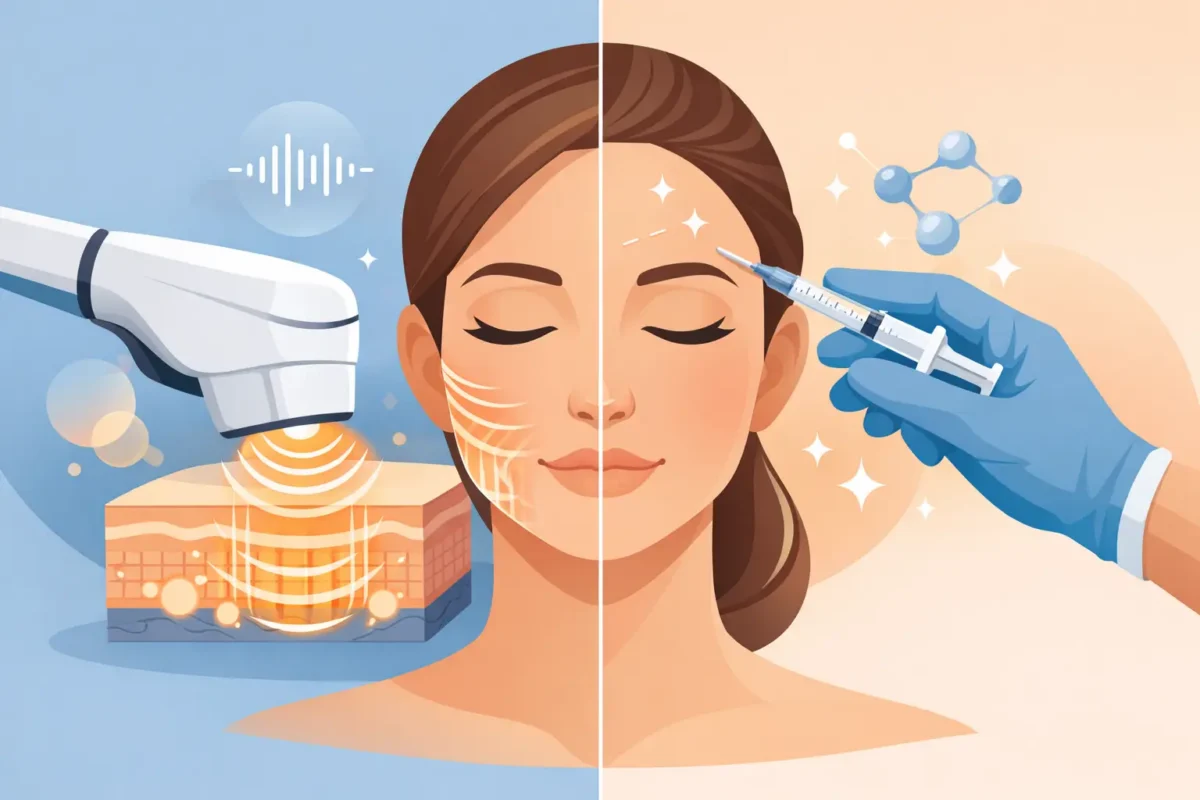
HIFU stands for high-intensity focused ultrasound. It uses ultrasound energy to target deeper layers of tissue under the skin, including the foundational layer often addressed in surgical lifting. The treatment creates controlled thermal points beneath the surface, which stimulates collagen production and gradually improves firmness.
Botox works in a completely different way. It is a neuromodulator injected into specific facial muscles to reduce movement. When those muscles relax, expression lines soften. This makes Botox especially effective for forehead lines, frown lines between the brows, and crow’s feet.
So the simplest way to think about it is this: HIFU treats laxity and structural sagging, while Botox treats movement-related wrinkles. Both support facial rejuvenation, but they are not interchangeable.
When HIFU makes more sense
If your main concern is skin that feels less firm than it used to, HIFU is often the better match. It can be especially useful for mild to moderate sagging around the lower face, jawline, cheeks, and under the chin. Some clients also choose it for brow support or neck tightening.
What makes HIFU appealing is that it works below the surface without injections or surgery. There is no need to freeze facial movement, and results build over time as collagen remodeling takes place. That gradual change is part of the appeal for many people. You still look like yourself, just tighter, smoother, and more rested.
HIFU tends to be a strong option for clients who are starting to notice age-related descent rather than just lines. If you look in the mirror and think, my face seems to be slipping downward, not just wrinkling, HIFU may be closer to what you need.
That said, it is not an instant treatment. You may see some early tightening, but full improvement usually develops over several weeks to a few months. It also has limits. If sagging is advanced, surgery may still produce a more dramatic result.
When Botox is the better choice
Botox is often the first treatment people think of for facial rejuvenation because it works quickly and predictably for certain wrinkles. If your forehead creases deepen when you raise your eyebrows, if your frown lines make you look tense, or if crow’s feet show up every time you smile, Botox is often the most efficient fix.
Because Botox reduces muscle activity, it can also help prevent expression lines from becoming more deeply etched over time. This makes it useful for both correction and prevention. Many clients start before lines are severe because they want to preserve a smoother look.
Results usually begin to appear within a few days and continue improving over about two weeks. That faster timeline makes Botox attractive before events, travel, or photos. Treatment sessions are also short, with minimal disruption to your day.
The trade-off is that Botox does not tighten loose skin or lift deeper facial structures. If your concern is jowling, a heavy lower face, or early skin laxity, Botox alone may leave you underwhelmed. It can soften wrinkles beautifully, but it will not replace lost support.
Which treatment lasts longer?
This is where expectations matter. HIFU generally lasts longer than Botox, but it also takes longer to show its full effect.
Botox results often last around three to four months, although this varies depending on the area treated, your metabolism, and how expressive your face is. Maintenance is part of the process if you want consistent smoothing.
HIFU results can last much longer, often several months to a year or more depending on age, skin quality, and how much collagen support your skin can still produce. Some clients benefit from periodic maintenance treatments to keep that lifted look going.
Longer-lasting does not always mean better. If you want a treatment that can be adjusted frequently and targeted with precision, Botox has an advantage. If you prefer collagen-focused improvement with less frequent maintenance, HIFU may be more appealing.
Downtime, comfort, and what to expect
Neither treatment is surgical, which is a major reason they are both so popular. Still, the treatment experience feels different.
Botox is quick. The injections are brief, and most people return to normal activities right after treatment. You may have minor redness, swelling, or tiny bumps at the injection sites, but these usually fade quickly.
HIFU involves passing an ultrasound device over the treatment area. Clients may feel warmth, tingling, or brief zaps of energy during the session. Comfort levels vary by person and by area treated. Some patients find it very manageable, while others feel more sensitivity along bony areas like the jawline.
After HIFU, mild tenderness, swelling, or temporary redness can occur, but there is usually little to no true downtime. The bigger difference is not recovery. It is patience. Botox gives a faster payoff. HIFU rewards the client who is willing to wait for collagen to do its work.
HIFU vs Botox facial rejuvenation by concern
If the concern is forehead lines, frown lines, or crow’s feet, Botox is typically the stronger choice. These lines are caused by repeated muscle movement, and relaxing that movement addresses the source.
If the concern is a softer jawline, mild jowling, early sagging, or a less defined lower face, HIFU is often more appropriate because it targets tissue support and firmness.
If the concern is under-eye creasing, etched static wrinkles, or volume loss, neither treatment may be the full answer on its own. In those cases, combination treatment with skin resurfacing, collagen stimulation, or dermal filler may make more sense.
This is why a proper consultation matters. The best treatment is not the trendiest one. It is the one that matches the reason your face looks different.
Can you combine HIFU and Botox?
Yes, and in many cases that is where the most balanced rejuvenation happens.
A client might use Botox to soften the upper-face lines caused by expression, while using HIFU to support tightening through the cheeks, jawline, and neck. That combination can create a refreshed look that is noticeable without seeming overdone.
This layered approach works because aging is layered. Muscles, collagen, skin texture, and facial support all change over time. Treating only one piece can help, but treating the right two or three pieces often creates a more complete result.
At a clinic like Bloom Laser Clinic, where non-surgical facial rejuvenation is approached with both technology and clinical judgment, combination planning can be tailored rather than one-size-fits-all. That matters when your goal is to look better, not artificially altered.
What about cost?
Cost depends on the treatment area, provider expertise, and how much correction you need. Botox is often less expensive upfront, especially for smaller areas like crow’s feet or frown lines. But because it requires repeat visits, the ongoing cost adds up over time.
HIFU often has a higher initial price because it is a device-based treatment covering larger structural areas. However, because results can last longer, some clients see value in the lower maintenance frequency.
The smarter way to think about cost is not cheapest per visit. It is which treatment will actually address your concern. Spending less on the wrong treatment is still wasting money.
How to choose with confidence
If your face looks tired because it is moving too much in certain areas, Botox is likely the better fit. If your face looks tired because it is losing firmness and lift, HIFU may be the stronger option.
If you are dealing with both, that is normal. Most people are not choosing between wrinkles or sagging. They are noticing a mix of changes. A medically informed consultation can separate what is caused by muscle activity from what is caused by collagen loss and tissue descent.
That is where real facial rejuvenation becomes smarter. Not more treatment. Better-targeted treatment.
The best results rarely come from chasing a single fix. They come from choosing the treatment that matches your face right now, your comfort level, and how you want to age. When the plan is right, you do not look frozen or pulled. You look like you have been taking very good care of yourself.