


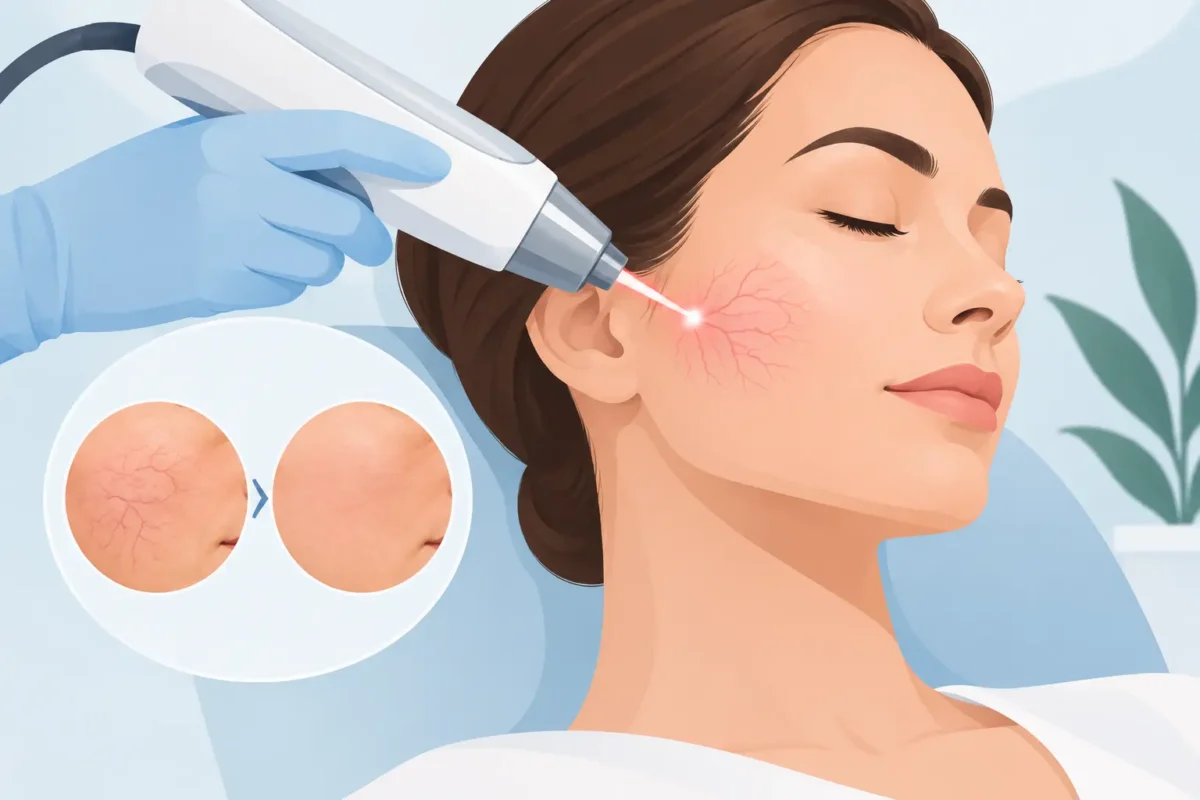
Those fine red lines around the nose or across the cheeks can be surprisingly difficult to conceal. Makeup may soften their appearance, but it does not address the visible blood vessels beneath the skin. Understanding how laser clears facial veins can make the treatment feel far less mysterious – and help you decide whether it is the right next step for clearer-looking, more even skin.
What facial veins are and why they become visible
Facial veins are commonly called broken capillaries, spider veins, or telangiectasia. They can appear as tiny red, purple, or blue lines, most often on the nose, cheeks, chin, and around the mouth. Despite the name, these vessels are not usually “broken.” They have simply become enlarged or more noticeable near the surface of the skin.
Genetics can play a role, as can sun exposure, rosacea, heat, cold weather, pregnancy, aging, and repeated flushing. Some people notice them after years of outdoor activity; others develop them as part of a rosacea pattern. Because the causes vary, an experienced consultation matters. A visible vein may be an isolated vessel that responds quickly to laser treatment, while broader redness may need a more comprehensive approach.
How laser clears facial veins beneath the skin
Laser treatment works through a highly targeted interaction between light and hemoglobin, the pigment in red blood cells. The device delivers a specific wavelength of light that is attracted to the blood within the visible vessel. That light converts to heat, causing the vessel wall to collapse or coagulate while preserving the surrounding skin as much as possible.
After treatment, the body gradually processes the treated vessel. It is not pulled out or drained during the appointment. Instead, the vessel becomes less visible as the body naturally clears it over the following days or weeks.
This selective approach is why laser technology can be so effective for small facial vessels. The goal is to treat the color inside the vessel, not to broadly damage the skin around it. Settings must still be carefully chosen based on the vessel’s size, depth, color, location, and your skin type. A small red capillary on the cheek may require a different approach than a deeper blue vessel near the side of the nose.
Laser treatment is not the same as treating every type of redness
Not all redness is caused by visible vessels alone. Rosacea, irritation, acne inflammation, melasma, sun sensitivity, and certain skin conditions can all create a red or uneven appearance. Laser may be an excellent option for prominent veins, but it may not be the complete answer if your concern is diffuse flushing or persistent inflammation.
That is why a proper skin assessment should come before treatment. Your provider can identify whether the concern is primarily facial veins, generalized redness, pigmentation, or a combination. A personalized plan may include laser vein reduction alongside medical-grade skincare, sun protection, or additional treatments designed for rosacea-prone or reactive skin.
What happens during a facial vein laser appointment
Treatment begins with clean, makeup-free skin and a review of your health history, current medications, and recent sun exposure. Protective eyewear is worn throughout the procedure. Your provider then applies laser pulses directly over the target vessels.
Most clients describe the sensation as a quick snap of warmth, similar to a small rubber band against the skin. Treatment areas are typically small, so appointments are often efficient. Some laser platforms use cooling features to improve comfort and protect the skin’s surface.
You may notice an immediate change in the treated vessel. It can appear lighter, darker, or temporarily more pronounced before it fades. Mild redness, warmth, and slight swelling are also common, especially around the nose and cheeks. These reactions are usually temporary and part of the normal healing response.
When you can expect to see results
Some veins fade immediately, while others need time to respond. In many cases, improvement becomes more apparent over one to three weeks as the body clears the treated vessels. Larger or deeper veins may take longer, and some may require more than one session for the best visible result.
The number of treatments depends on the concern. A few isolated capillaries may respond beautifully after one appointment. Diffuse redness, recurring rosacea-related vessels, or a network of veins across the cheeks may need a series spaced several weeks apart. Your treatment plan should be based on what your skin needs rather than a one-size-fits-all package.
Laser can clear treated vessels, but it cannot prevent every future vessel from appearing. Genetics, rosacea flare-ups, UV exposure, and environmental triggers can lead to new visible veins over time. Many clients choose occasional maintenance treatments to preserve their results.
Preparing for treatment and protecting your results
Healthy skin preparation helps support a safer, more predictable treatment experience. Avoid deliberate tanning, tanning beds, and prolonged unprotected sun exposure before your appointment. Tanned or sunburned skin may increase the risk of unwanted pigment changes and can affect which laser settings are appropriate.
Your provider should also know about medications, supplements, topical products, and medical conditions that may affect light sensitivity or healing. Do not stop prescription medications without direction from the prescribing clinician. If you use retinoids, exfoliating acids, or other active skincare ingredients, you may be asked to pause them for a specified period before and after treatment.
After your session, treat the skin gently. Keep it cool, avoid intense heat such as saunas and hot yoga for the timeframe recommended by your provider, and avoid picking or scrubbing the area. Broad-spectrum sunscreen is essential. Daily sun protection does more than protect your investment – it helps limit UV-related vascular changes and supports a more even-looking complexion.
Is laser facial vein treatment safe for everyone?
When performed by trained professionals using appropriate technology and settings, laser vein treatment is a well-established non-surgical option for many adults. Still, it is not right for every person at every time. Recent tanning, active infection or irritation in the treatment area, certain medications, a history of abnormal scarring, and some medical conditions may require postponing treatment or choosing another approach.
Skin tone also matters. Different skin types can be treated, but the device, wavelength, and settings need to be selected carefully to reduce the risk of pigmentation changes. This is not a treatment to approach casually or based on a generic online recommendation. Clinical judgment is central to both safety and results.
Potential side effects can include temporary redness, swelling, tenderness, bruising, darkening of a vessel, or temporary pigment changes. Less common risks include blistering or scarring. Following pre- and post-treatment instructions and choosing a qualified clinic significantly supports a smooth recovery.
Choosing treatment for clear, confident-looking skin
The most satisfying results tend to look natural: skin that appears calmer, more even, and less dependent on concealer. The visible vessel has been reduced, but your facial features still look like you. That balance of clinical precision and subtle refinement is what makes laser treatment such a compelling option for facial veins.
At Bloom Laser Clinic, treatment planning begins with your specific skin concern, not a predetermined protocol. Whether you are bothered by a single persistent vein around the nose or facial redness that has become harder to ignore, an individualized assessment can clarify the most appropriate next step.
A clearer complexion is rarely about chasing perfection. It is about feeling comfortable in your skin, seeing less of the concern that catches your eye in the mirror, and choosing care that respects both your confidence and your skin’s needs.